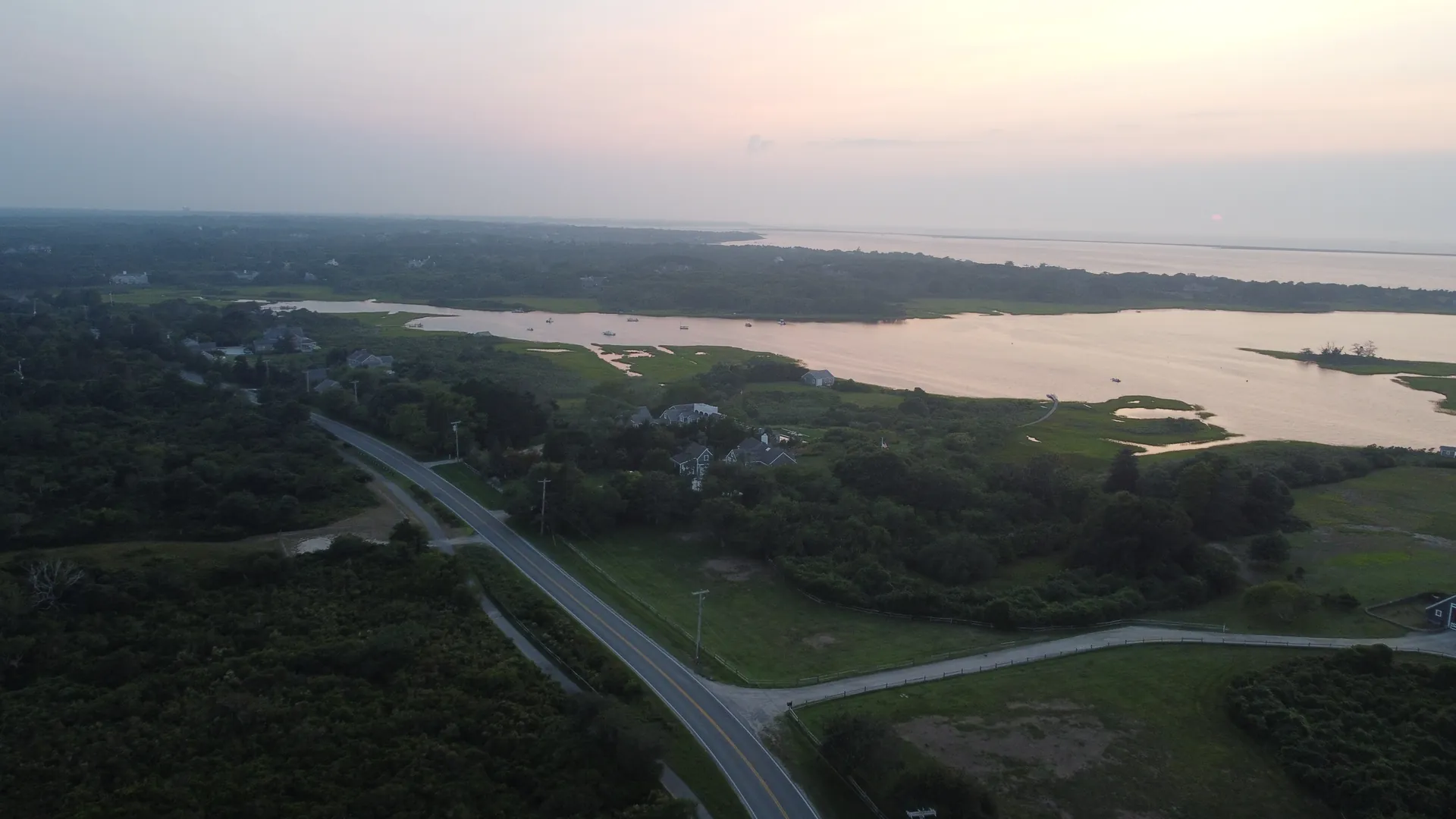
Ten minutes east of town, Polpis Road slips past cranberry bog and conservation land before the harbor opens up — and almost nothing about it is for sale very often.
The approach is half the point
Leave town on Polpis Road and the character of the island changes almost immediately. The route runs past the Shipwreck and Lifesaving Museum, then through open moors, split-rail fences, and cranberry bog before the harbor comes into view. It’s about 10 to 11 minutes from downtown Nantucket, with ’Sconset another 10 minutes further east and Quidnet and Sesachacha beaches just a few minutes off the road. The approach alone tells you what the neighborhood is selling: space, with town still close enough to reach for dinner.
A harbor built for using, not just looking at
Polpis fronts Polpis Harbor, a protected, calm body of water suited to daily use rather than open-ocean sailing: kayaking, a small boat on a mooring, flat water. The most desirable parcels sit directly on the harbor, and a handful carry legacy private docks. Zoning has prohibited new private docks on Nantucket shorefront for years now, so those existing dock rights are effectively finite. They rarely reach the market, and when they do, they carry a real premium over a harborfront lot without one.
Room to build, bounded by what’s permanently protected
Lots in Polpis commonly run one to three-plus acres, and large Nantucket Conservation Foundation tracts border much of the neighborhood, permanently protected, keeping density low and sightlines long. That combination — real acreage next to land that can never be developed — makes Polpis one of the few corners of the island where designing a house from scratch, rather than buying something already built, is a genuine option. It comes with real conditions, though. There’s no town sewer out here, so septic capacity runs under Title 5, and harbor-watershed parcels may need a nitrogen-reducing system, worth pricing before you fall for a lot. Low harborfront parcels can also fall inside flood mapping, and conservation or wetland setbacks can shrink the buildable envelope well below what the acreage on paper suggests — worth a feasibility and HDC check before you assume what a lot can actually support.
A thin market, not a slow one
Polpis doesn’t turn over the way other neighborhoods do. Only one sale closed there across the first eight months of 2026 — a $7,675,000 trade against an $8,495,000 ask — which reads as a thin market rather than a cooling one, since Polpis properties are typically held for a generation and passed down rather than listed. As of early September, the handful of active listings ranged from just under $6 million to $33 million, with a median ask north of $9.5 million, numbers that place Polpis squarely in the island’s luxury tier, with effectively no entry-level option.
What draws people to Polpis
The draw in Polpis comes down to a short list: acreage, calm water, and a short drive to town rather than a walk to it. Rental demand runs strong in high season for exactly that combination, and the tenants who find it tend to come back summer after summer. Most houses here are held rather than rented, though. The property itself, not the rental income, is the point, which is part of why turnover stays so low from one generation to the next.
Exterior changes on the island, Polpis included, go through the Historic District Commission, so any renovation to one of these houses follows the HDC’s own schedule rather than a contractor’s. And if Polpis is on your list, it’s worth weighing it against its closest neighbor: Wauwinet shares the same harborside character and many of the same septic and dock-rights considerations, but sits further from town and carries its own tradeoffs.
If a quiet, acreage-driven corner of the island like Polpis is the kind of property you’re picturing — whether that’s buying raw land or an existing harborfront house — I’m happy to walk you through what’s realistic to find and what it actually takes to build there. Email me at sean@thekalmanco.com.